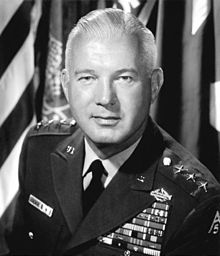
The counterattack by the American 25th Division west of Masan. The battle of the Bloody Gulch. The murder of American prisoners of war by the North Koreans. The American 25th Division withdraws back to its start line. A biography of Major General Keen the commander of the American 25th Division.
These weapon was the mainstay of the North Korean and Chinese Artillery during the Korean War. Heavily used by the Soviet Army during the Second World War, it was effective weapon. It had a range of over 11 kilometres, could fire five rounds a minute. It needed a crew of 8 to operate. The problem was however that once the firing position of the howitzer was detected it be bombed by the American air force.
This Soviet made mortar played an vital role in support of Chinese and North Korean infantry. With artillery often in short supply to aid their infantry attacks, Mortars give the Communists indirect fire support to use against United Nations defensive positions and when the enemy attacked their own lines. The mortar shells on impact shattered into a shower of lethal fragments.
This machine gun gave an American Infantry Company the heavy firepower to mown down enemy infantry trying to attack their position. It fired 600 rounds a minute feed by a 250 round belt. It weighed 14 kilograms and had a effective range of 1,400 metres. It needed a two man to operate it. Five million were built and it was heavily used during the Second World War and the Korean War. It went to be used during the Vietnam War.
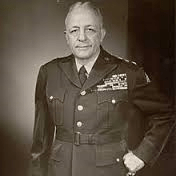
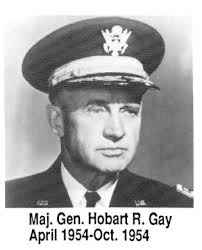
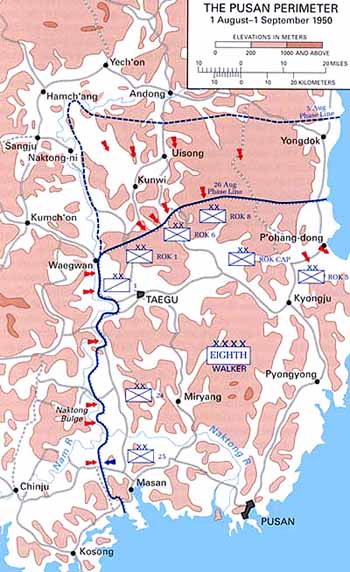
The balance of power begins to swing against the North Koreans. A description of the terrain along the Pusan Perimeter. The heat and lack of water in August 1950. The disposition of the American, South Korean and North Korean Divisions along the Pusan perimeter. The M26 Tank now arrives in large numbers to aid the American Army. A biography of Major General Gay the commander of the American 1st Cavalry Division.
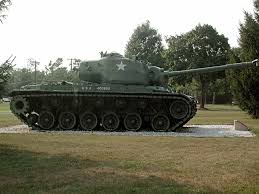
The M26 tank was developed during the Second World War as an improvement upon the M4 Sherman Tank. Over 2,000 were built. The tank had a 90 millimetre gun and three machine guns. There were five crew and it had a on road speed of 40 kilometres an hour. the armour on some parts of the tank was up to 120 millimetres thick. It weighted over 41 tons.
The M26 Tank proved superior to both the T34 and M4 tanks in battle.
American Air supremacy. The poor nature of Korean roads. The importance of the port of Pusan. The logistical command of the Eight Army. The control of the seas off Korea by the naval forces of the United Nations. A biography of Admiral Joy the commander of the United Nations naval forces.
Nicknamed ‘The Mighty Mo’, the Battleship arrived off the coast of Korea in September 1950. During the Korean War it undertook shore bombardment with her massive guns in support of United Nations forces. It had nine 16 inch naval guns which could fire a 1,200 kilogram shell over 30 kilometres. It also had twenty 5 inch guns. It had a crew of 2,700 men.
The Japanese surrender took place on board in 1945. The battleship not only took part in the Second World War and the Korean War but would go on to serve in the First Gulf War. It is now a museum ship in Pearl Harbour.
The number of monthly downloads continues to grow. The podcast now has listeners from Algeria, Australia, Belgium, Brazil, Canada, China, Denmark, Ecuador, Finland, France, Germany, Greece, Indonesia, Ireland, Israel, Italy, Japan, Kuwait, Lithunia, Malaysia, Mexico, Netherlands, Norway, Oman, Philippines, Portugal, Russia, Saudi Arabia, South Africa, South Korea, Spain, Suriname, Sweden, Ukraine, United Kingdom, United States, Ukraine and Vietnam.
The podcast is now entering the next stage, episode 19 to 29 will deal in depth with the battle for the Pusan perimeter. The first two episode will look at the background to the battle. Here is a map of the battlefront.
The battle of the Pusan perimeter
Episode 30 to 34 will dealt with the Inchon landings and the conquest of most of Korea by the United Nations forces. Episode 35 to 49 will deal with the Chinese military intervention in Korea. The stalemate in the battle lines between summer of 1951 and 1953 will be dealt in episode 50 onwards but as the nature of the war changes so the format will need to change from a narrative time based account to a more themed based episodes.
The American defeat at the Chinju. The American counter attack towards the Chinju pass. The American defeat of the North Korean 6th Division at Chindong. A biography of Colonel Michaelis the commander of the American 27th Infantry Regiment.






 koreanwarpodcast
Recent Comments